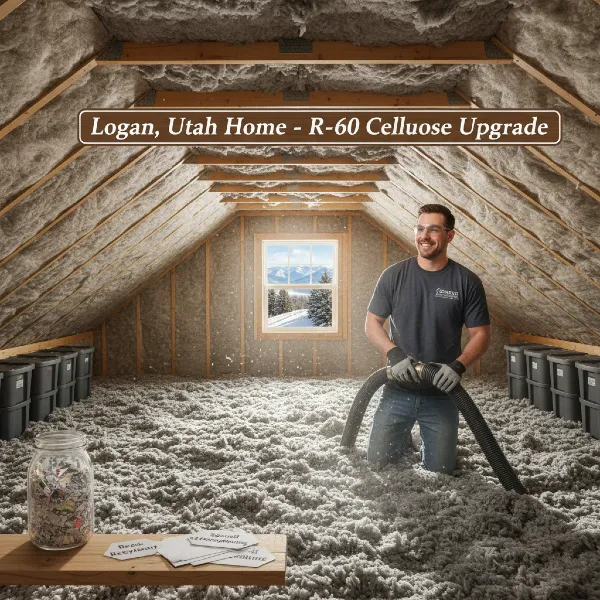
Warming Up the Valley: 10 Things to Know About Cellulose Insulation in Logan
Living in Cache Valley means embracing a life of beautiful contrasts—from the vibrant autumn leaves on Old Main Hill to the deep, sparkling snow that settles over the Wellsville Mountains. But for homeowners in Logan and the surrounding towns like Smithfield, Hyrum, and Wellsville, those crisp winters bring a specific challenge: keeping the house warm without watching your heating bill climb as high as Logan Peak.
If you’re looking for a way to upgrade your home’s energy efficiency, cellulose insulation in Logan is often the unsung hero of the insulation world. It’s eco-friendly, incredibly effective in our specific climate, and offers some unique benefits that other materials simply can't match.
Whether you’re tucked away in a historic home in the Island district or settling into a new build in North Logan, here are 10 essential things to know about choosing cellulose for your home.
1. Superior Thermal Performance in Extreme Cold
In Logan, "cold" is an understatement when the inversion sets in. Cellulose insulation is made of dense, recycled paper fibers that are blown into attics and wall cavities. Because it is so dense, it does a fantastic job of preventing "thermal bridging" and convective heat loss. Unlike some fiberglass products that can lose a bit of their effectiveness as the temperature drops drastically, cellulose maintains a consistent R-value. For those living in the breezier parts of the valley like Richmond or Trenton, this density helps keep the warmth exactly where it belongs—inside your living room.
2. It’s the Ultimate Eco-Friendly Choice
If sustainability is a priority for your family, cellulose is the clear winner for home insulation in Utah. It is typically composed of 80% to 85% recycled newsprint and cardboard. By choosing cellulose, you are essentially "locking" recycled paper into your walls for decades, keeping it out of the local landfills. It takes significantly less energy to manufacture cellulose than it does to produce fiberglass or spray foam, making it the "greenest" way to stay warm in the valley.
3. Exceptional Air Sealing Properties
One of the biggest culprits of high energy bills in older homes—especially the beautiful pioneers of Providence and River Heights—is air infiltration. Because cellulose is a "blown-in" product, the small fibers pack tightly into every nook, cranny, and irregular space. It flows around electrical boxes, plumbing pipes, and over uneven joists, creating a much tighter seal than traditional batts. This reduces drafts, which is a game-changer when the canyon winds start howling.
4. Fire Resistance That Might Surprise You
It sounds counterintuitive—putting paper in your walls to prevent fire? However, cellulose is treated with borates, a naturally occurring mineral. These borates act as a powerful fire retardant. In fact, cellulose is often more fire-resistant than fiberglass. In a fire, the dense cellulose fibers char and create a barrier that slows the spread of flames and limits the oxygen available to the fire. It’s a peace-of-mind upgrade for any homeowner.
5. A Natural Deterrent for Pests and Mold
Those same borates that provide fire resistance also act as a permanent pest control. We all know that as the weather cools in Millville or Nibley, field mice and insects look for a warm place to spend the winter. Cellulose is highly unappealing to these critters. Additionally, the borate treatment makes the insulation resistant to mold and mildew. Given that we occasionally deal with moisture from heavy snowmelt, having an insulation that doesn't support mold growth is a major health benefit for your indoor air quality.
6. Excellent Sound Dampening
Do you live near a busy corridor like Main Street or 400 North? Or perhaps you just want a quieter home environment? Because cellulose is so dense, it is an incredible sound insulator. It traps sound waves within its fiber structure, significantly reducing the noise that travels between rooms or from the outside world. This makes it a popular choice for families in the denser neighborhoods of Logan who want a peaceful sanctuary from the hustle and bustle.
7. It’s Perfect for "Drill and Fill" Retrofits
If you own an older home that currently has empty wall cavities, you don't have to tear down your drywall to insulate. Cellulose is the primary material used for "drill and fill" applications. Insulation contractors in Logan can drill small holes in your exterior or interior walls and blow the cellulose in under high pressure, packing the cavity solid. This is one of the most cost-effective ways to transform an old, drafty house into a modern, energy-efficient home without a full-scale renovation.
8. Understanding R-Value and Settling
When you talk to an expert about insulation installation in Logan, they will mention R-value. Cellulose typically has an R-value of about 3.2 to 3.8 per inch. One thing to know is that blown-in cellulose will settle slightly over the first few months after installation. Professional installers account for this "settled thickness" from the start to ensure that you are getting the full R-value you paid for. In our climate zone, aiming for an R-60 in the attic is a smart move to maximize your savings.
9. Moisture Management is Key
While cellulose is treated to be mold-resistant, it is still a paper-based product. This means it’s important to ensure your roof is in good repair and that your attic is properly ventilated before installation. In the Logan, Utah area, where we get heavy snow loads, ice dams can sometimes cause leaks. Making sure your "attic floor" is air-sealed before blowing in cellulose ensures that warm, moist air from your house doesn't get trapped in the insulation, keeping everything dry and effective.
10. Eligibility for Utah Energy Rebates
Perhaps the best news for homeowners is that upgrading to cellulose insulation often qualifies you for significant rebates. Programs through local utility providers frequently offer incentives for increasing your attic insulation to a certain R-value. When you work with a professional team like Bonded Insulation, Inc., they can often help you navigate the paperwork to ensure you get the maximum rebate back, making the investment in your home's comfort even more affordable.
Conclusion: A Cozier Future in Cache Valley
Choosing the right insulation is about more than just numbers on a page; it’s about how your home feels on a Tuesday morning in January when the thermometer reads -5°F. Cellulose insulation offers a unique combination of warmth, safety, and environmental responsibility that fits the spirit of our community perfectly.
From the quiet streets of Hyde Park to the growing neighborhoods of Smithfield, every home in the valley can benefit from the dense, protective blanket that cellulose provides. If you're ready to stop shivering and start saving, it might be time to look into what a fresh layer of cellulose can do for you.
