Understanding R-Value: A Homeowner's Guide to Measuring Insulation in Ogden, Utah
If you’ve spent a winter in the East Bench or a summer near Mount Ogden, you know that the weather in Northern Utah isn't just a topic for small talk—it’s a battle for your thermostat. One minute you’re shoveling lake-effect snow, and the next, you’re trying to keep the July heat from turning your upstairs into a sauna.
When homeowners in neighborhoods like Shadow Valley or the historic Jefferson District start looking for ways to lower their utility bills, the term "R-value" inevitably comes up. But what is it, exactly? And more importantly, how do you know if your home has enough of it to keep you comfortable and qualify for those lucrative Utah insulation rebates?
What is R-Value? (The "Blanket" Analogy)
In technical terms, R-value is a measure of thermal resistance. It tells you how well a specific material—be it pink fiberglass, grey cellulose, or modern spray foam—resists the flow of heat.
+1
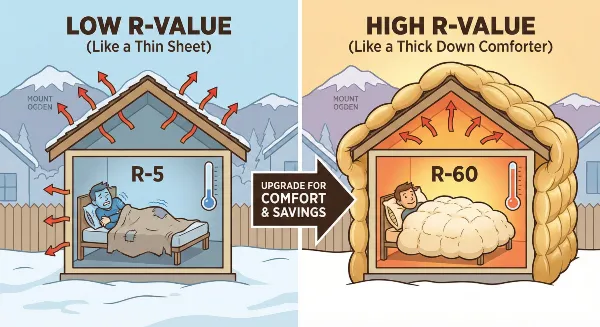
Think of R-value like the "tog" rating on a winter quilt. A thin sheet has a low R-value; it won't do much to keep the heat in when the wind is whipping off the Wasatch Mountains. A thick, down comforter has a high R-value; it traps heat effectively. In your home, a higher R-value means heat stays inside during the winter and stays outside during the summer.
In Utah, where we experience extreme temperature swings, having the right R-value isn't just about comfort; it's about making sure your furnace and air conditioner don't burn out prematurely.
How Much R-Value Does an Ogden Home Need?
The Department of Energy and local utility programs like ThermWise and Wattsmart have specific standards for our climate zone.
Attics: For most existing homes in Ogden, the goal is to reach a total of R-49 to R-60.
Walls: Exterior walls should ideally be R-13 to R-21.
Floors: Over unheated crawlspaces, you’re looking for R-30.
If you live in one of the newer developments in West Ogden or North Ogden built after 2015, your home likely already meets these standards. However, if you live in a charming bungalow near 25th Street or a mid-century rambler in South Ogden, there is a high probability your current R-value is significantly lower than what is recommended for 2026.
Step-by-Step: How to Find Your Current R-Value
You don't need a degree in engineering to figure out your home's current insulation level. You just need a flashlight, a sturdy ruler (or tape measure), and a bit of courage to climb into the attic.
1. Identify Your Insulation Type
Not all insulation is created equal. Before you measure the depth, you need to know what material you’re looking at. Here are the most common types found in Ogden homes:
Insulation Type What it Looks Like R-Value per Inch (Approx.)
Fiberglass Batts Pink, yellow, or white "blankets" or rolls. 3.0 – 3.7
Blown-in Fiberglass Loose, fluffy white or pink fibers. 2.2 – 2.9
Cellulose Grey, recycled paper-like material (fluffy). 3.2 – 3.8
Rock Wool Dense, grey/brown fiber (feels like wool). 3.0 – 3.3
Vermiculite Small, shiny silver/brown pebbles (Caution: see below). 2.0 – 2.5
Safety Warning: If you see "pebbly" insulation (vermiculite) in an older home, do not disturb it. Some vermiculite contains asbestos. Consult a professional before measuring.
2. Measure the Depth
Once you’ve identified the material, take your ruler and "dip" it into the insulation until it hits the floor of the attic (the drywall or wooden joists).
Take multiple measurements: Insulation often settles or shifts. Check near the eaves (the edges) and near the center of the attic to get an average depth.
Note the Joists: If you can see the wooden ceiling joists, you almost certainly have less than R-19. Most joists are 2x6 or 2x8 inches; if they aren't completely covered, you are significantly under-insulated for Utah winters.
3. Do the Math
Now, multiply your average depth by the "R-value per inch" of your material.
Formula: Depth (inches) × R-Value per Material = Total Current R-Value
Example: You live in the East Central neighborhood and find 6 inches of old, grey cellulose.
6 inches × 3.7 (Cellulose) = R-22.2
Since the Utah target for 2026 is at least R-49, this home is a prime candidate for a rebate-supported upgrade.
Why "Settling" Matters in Older Neighborhoods
If you are in the Lower East Bench or Lynn neighborhoods, your insulation might have been installed decades ago. Over time, materials like cellulose and blown-in fiberglass "settle" due to gravity and humidity.
When insulation settles, it becomes denser, which actually decreases its effectiveness. If you have 10 inches of insulation that has been packed down until it’s hard, it won't perform as well as 10 inches of fresh, fluffy material. If your insulation looks matted or has been disturbed by past roof leaks, its actual R-value may be even lower than your measurements suggest.
Bridging the Gap to Savings
Knowing your current R-value is the first step toward a more comfortable home and lower monthly bills. In Ogden, many utility programs require your attic to be at R-20 or less to qualify for the maximum rebate to bring it up to R-49 or R-60.
By taking ten minutes to measure your attic today, you could save hundreds (or even thousands) of dollars on an upgrade that will keep your home warm when the canyon winds howl and cool when the Utah sun is at its peak.
