Navigating Energy Compliance: Why a REScheck for Insulation is Vital for Northern Utah Homes
Embarking on a residential construction project in Northern Utah is an ambitious endeavor that requires balancing aesthetic desires with stringent structural realities. Whether you are breaking ground on a custom estate in the Shadow Mountain area of Ogden or planning a modern craftsman home in the Hillcrest neighborhood of Logan, energy efficiency is a central pillar of your build. In Utah’s regulatory landscape, the most effective way to validate this efficiency is through a REScheck report.
To the uninitiated, "REScheck" may sound like a bureaucratic hurdle, but for the savvy homeowner, it is a powerful diagnostic tool. Understanding the importance of a REScheck for insulation—and the specific performance data it yields—is the key to securing a building permit and ensuring your home remains a sanctuary against Utah's extreme seasonal shifts.
Defining the REScheck Standard
A REScheck (Residential Energy Services Check) is a standardized compliance method developed by the Department of Energy. It determines if a residential building’s envelope meets the requirements of the International Energy Conservation Code (IECC).
Because Utah has adopted specific versions of these codes with local amendments, a REScheck serves as a localized proof of performance. It analyzes the "thermal envelope"—the shell of your home—to ensure that the heat loss through your walls, roof, and windows does not exceed the legal limits established for our specific climate.
The High Stakes of Utah’s Climate Zones
The climate in Northern Utah is unforgiving. Residents in the Bridger neighborhood of Logan deal with some of the coldest winter inversions in the country, while those living near Waterfall Canyon in Ogden experience intense summer heat radiation from the mountain faces. A REScheck ensures your insulation strategy is specifically engineered for these conditions.
The Science of Thermal Resistance: R-Values and U-Factors
The technical heart of any REScheck report lies in two specific measurements:
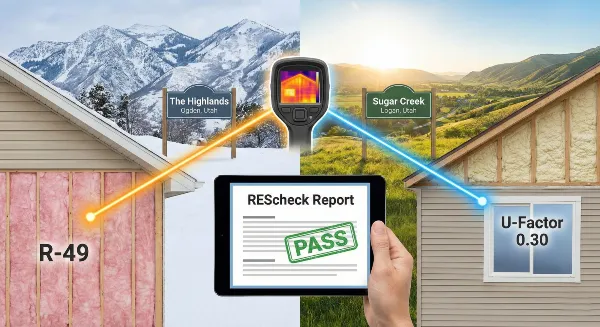
R-Value: This measures how well a specific insulation material resists heat flow. In the Mountain Gate community of Ogden, where winter winds can be fierce, high R-values in the attic (often R-49 or higher) are non-negotiable for keeping heating costs manageable.
U-Factor: Primarily applied to windows and glass doors, this measures the rate of heat transfer. The lower the U-factor, the better the window is at insulating. For homes in Logan's Lundstrom Park, selecting windows with a low U-factor prevents the "chilled glass" effect during sub-zero January nights.
Deciphering the Report: What Homeowners See
When your contractor or energy consultant hands you a completed REScheck, it provides a transparent look at your home’s future performance. It generally breaks down into two vital components:
1. The Energy Compliance Certificate
This is the high-level summary. It documents exactly what is being built into your walls and ceilings. It details the R-values for the ceiling, wood-framed walls, basement walls, and the floor over unconditioned spaces. For a homeowner, this certificate is your guarantee that the high-quality materials you paid for are actually part of the approved design.
2. The Detailed Inspection Checklist
This document is a tactical guide for the build phase. It ensures that the insulation contractor doesn't just "stuff the batts" into the walls but follows critical air-sealing protocols. It covers requirements for sealing the "rim joist" (the area where the house frame meets the foundation) and ensuring proper attic ventilation with baffles—steps that are crucial for preventing ice dams in snow-heavy areas like The Island in Logan.
Architectural Freedom through the "Trade-Off" Method
Perhaps the greatest benefit of a REScheck for insulation is the flexibility it offers through UA Trade-offs. Under a strict prescriptive code, every single component must meet a set number. REScheck, however, looks at the house as a single, holistic system.
If you are designing a home in the East Bench of Ogden and want expansive glass walls to maximize the valley view, those windows might naturally fall below the standard efficiency code. With a REScheck, you can "trade" that loss by over-insulating elsewhere—perhaps by using high-performance spray foam in the roof deck or thicker continuous insulation on the exterior. This allows residents in neighborhoods like Logan’s Logan River Estates to achieve stunning architectural designs without sacrificing energy compliance.
Securing Your Building Permit and Your Future
In most jurisdictions across Weber and Cache Counties, a passing REScheck is a mandatory attachment for a building permit application. Local building officials use this data to ensure new growth doesn't overwhelm the local power grid.
Beyond the permit, the report protects your investment:
Avoiding Costly Mid-Build Corrections: Discovering that your window specs don't meet code after they've been installed is a financial nightmare. A REScheck catches these discrepancies while they are still just lines on a blueprint.
Long-Term Utility Savings: By verifying that your home meets the 2021 IECC standards, you are effectively capping your future energy expenditure.
Eliminating Hot and Cold Spots: A REScheck-verified home provides uniform comfort. You won't have a freezing master suite in Woodbury Heights (Ogden) while the rest of the house is warm; the report ensures the thermal envelope is consistent and balanced.
Conclusion: Data-Driven Comfort
Whether you are building in the historic avenues of Logan or the rising developments of Taylor Ridge in Ogden, the importance of a REScheck for insulation cannot be overstated. It is the bridge between a set of blueprints and a high-performance home that will stand the test of Utah’s rugged climate for decades.
By utilizing this report, you aren't just checking a box for the city—you are ensuring your home is a documented leader in energy efficiency, comfort, and long-term value.
Building Comp Climate Zone 3 (So. Utah) Climate Zone 5 (No. Utah) Climate Zone 6 (Mtns)
Ceiling / Attic R-38 R-49 R-49
Wood Frame R-20 or R-13+5ci R-21 or R-15+5ci R-21 or R-15+5ci
Floor R-19 R-30 R-30
Basement Wall R-13 or R-5ci R-15ci or R-19 R-19 or R-15ci
Slab NR (Not Required) R-10 (2 ft depth) R-10 (4 ft depth)
Crawl Space R-13 or R-5ci R-15ci or R-19 R-19 or R-15ci
Fenestration .32 .32 .32
