Superior Comfort: Choosing the Best Insulation Options in Cache Valley for Your New Home Build
Building a new home in the heart of Northern Utah is an exciting venture, but it comes with unique environmental challenges. From the biting winter "inversions" in Logan to the summer heat in the south end of the valley, your choice of insulation is the single most important factor in your home’s year-round comfort and long-term energy efficiency.
In Cache Valley, the climate falls into Climate Zone 5, requiring a robust building envelope that can handle temperature swings ranging from sub-zero winter nights to 90-degree summer afternoons. For homeowners in growing communities like North Logan, Providence, and Nibley, selecting the right high-performance insulation today will pay dividends in lower utility bills for decades.
Understanding R-Value and Local Building Codes
Before diving into materials, it is essential to understand R-value—the measure of an insulation’s ability to resist heat flow. The higher the R-value, the greater the insulating power.
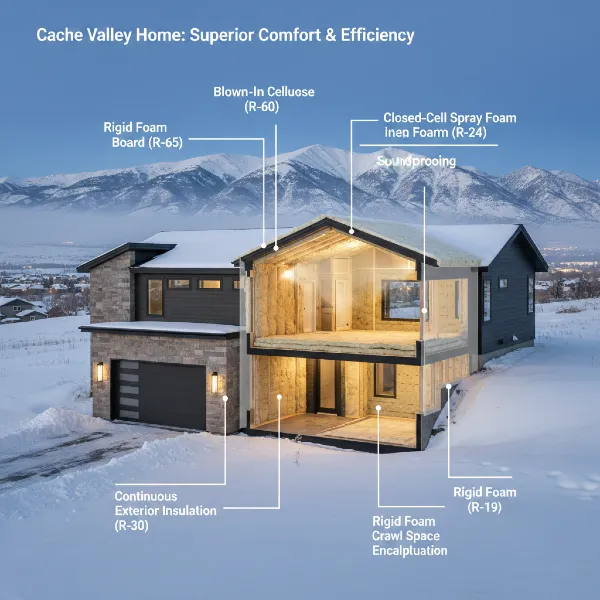
Under current Utah Residential Energy Codes, new home builds in Cache County typically aim for:
Attics: R-49 to R-60
Exterior Walls: R-20 to R-25
Basement/Crawl Space Walls: R-15 to R-19
For those building in windier or higher-elevation areas like Richmond, Clarkston, or the foothills of Hyde Park, many builders recommend exceeding these minimums to account for the increased "wind wash" that can pull heat from a home.
1. Spray Foam Insulation: The Gold Standard
If you are looking for the absolute best thermal performance for a custom home in neighborhoods like Cliffside or the Island in Logan, spray foam insulation is the premier choice.
Closed-Cell Spray Foam: This is the highest-density option, offering an impressive R-value of approximately R-6 to R-7 per inch. It acts as a 3-in-1 solution: insulation, air barrier, and vapor barrier. Because it hardens into a rigid structure, it actually adds structural integrity to your walls—a major plus for homes in the seismic-active areas of the Wasatch Front.
Open-Cell Spray Foam: A more affordable foam option that is excellent for sound dampening. It’s a popular choice for interior walls and media rooms in larger builds in Smithfield or Millville.
Why it works for Cache Valley: Spray foam excels at air sealing. It fills the tiny nooks, crannies, and "rim joists" where traditional insulation fails, preventing the freezing canyon winds from entering your living space.
2. Blown-In Cellulose: The Eco-Friendly Workhorse
For attics in new constructions across Hyrum and Wellsville, blown-in cellulose is often the preferred "bang-for-your-buck" option. Made from recycled paper treated with fire retardants, cellulose is denser than fiberglass.
Performance: It provides a seamless blanket of protection in the attic, covering the tops of ceiling joists to prevent "thermal bridging."
Key Advantage: Cellulose has a high heat capacity, meaning it holds onto the temperature of the house longer than many other materials. This is particularly effective during those long January stretches where the sun barely breaks through the valley's fog.
3. Fiberglass Batts and Blown-In-Blanket (BIBS)
Standard fiberglass batts remain the most common insulation for new builds due to their cost-effectiveness. However, for a truly high-quality build, many Cache Valley contractors now suggest the Blown-In-Blanket System (BIBS).
Instead of stuffing pre-cut batts into wall cavities, BIBS involves blowing loose-fill fiberglass behind a fabric mesh. This ensures a "Grade 1" installation with no gaps around electrical outlets or plumbing pipes—a common source of drafts in new homes in River Heights or Mendon.
4. Continuous Rigid Foam: Eliminating Thermal Bridging
A growing trend in high-performance homes—especially those aiming for "Net Zero" status—is the use of rigid foam board on the exterior of the house.
Even with great insulation inside the walls, heat can still escape through the wooden studs (thermal bridging). By wrapped the entire exterior of a home in Newton or Amalga with 1-2 inches of rigid foam before the siding or stone goes on, you effectively put a "cooler lid" over the entire structure. This is one of the most effective ways to combat the extreme winter chill of Northern Utah.
Strategic Focus Areas for Your Cache Valley Build
The Garage and "Bonus Room"
Many new homes in the Bridgerland area feature a "bonus room" above the garage. This is notoriously the hardest room in the house to keep comfortable. Using closed-cell spray foam in the garage ceiling (the floor of the bonus room) is non-negotiable here to prevent carbon monoxide and cold air from seeping into the living quarters.
Basement and Crawl Space Encapsulation
With the high water table in certain parts of the valley, such as Benson or parts of West Logan, moisture control is vital. Crawl space encapsulation using a heavy-duty vapor barrier and rigid foam insulation on the walls (rather than the floor joists) prevents the "stack effect," where cold, damp air is sucked up into your warm home.
Soundproofing Between Floors
If you are building a multi-generational home or a house with a basement apartment—a popular trend in Providence and Nibley—don't overlook sound insulation. Using mineral wool or open-cell spray foam between floors can significantly reduce the transfer of foot traffic noise and voices.
Conclusion: Investing in the Envelope
When building your dream home in Cache Valley, it’s easy to get caught up in the aesthetics of granite countertops and hardwood floors. However, the insulation hidden behind your drywall will have a much larger impact on your daily quality of life.
By combining spray foam for air sealing with blown-in cellulose or fiberglass for R-value, you create a home that remains a sanctuary, whether it’s a scorching July afternoon or a record-breaking February morning. Consult with a local insulation specialist who understands the specific demands of our Utah climate to ensure your new build is as efficient as it is beautiful.
