How Do I Know if My Home Qualifies for Insulation Rebates in Ogden, Utah?
Living in Ogden, Utah, means experiencing the full spectrum of the Wasatch Front’s climate. From the bone-chilling winter winds that sweep down from Mount Ogden to the sweltering triple-digit heat of July in West Ogden, our homes are constantly working to keep us comfortable. If your utility bills are skyrocketing or your upstairs bedrooms feel like an oven in the summer, your home is likely crying out for better insulation.
The good news is that the state of Utah and local utility companies offer some of the most robust energy-efficiency incentives in the country. But for many residents in neighborhoods like Shadow Valley, the East Bench, or the historic Jefferson District, the question isn't whether they need insulation—it’s whether they qualify for the cash back.
Here is everything you need to know about qualifying for insulation rebates in Ogden in 2026.
1. The Utility Provider Rule: Who Sends Your Bill?
The first hurdle in the qualification process is identifying your utility providers. In Ogden, insulation rebates are primarily funneled through two major programs: Wattsmart (offered by Rocky Mountain Power) and ThermWise (offered by Enbridge Gas, formerly Dominion Energy).
To qualify for Wattsmart rebates: Your home must be a residential customer of Rocky Mountain Power. Specifically, you must have a primary electric heating system (like a heat pump) or a centrally ducted electric cooling system (central air).
To qualify for ThermWise rebates: Your home must be heated by natural gas provided by Enbridge Gas on a qualifying GS rate schedule.
Pro Tip: If you have both gas heat and electric central air, you may actually be eligible for rebates from both companies, depending on the specific upgrade you are performing.
2. The "Primary Source" Requirement
One of the most common reasons Ogden homeowners are denied rebates is the "primary source" rule. To qualify for an attic insulation upgrade, your heating or cooling system must serve at least 80% of the home's conditioned living space.
Electric Requirements: If you are applying for a Rocky Mountain Power rebate, you generally must have a permanently installed electric heat pump or a ducted central air conditioner.
What Doesn't Qualify: Unfortunately, if you rely on "swamp coolers" (evaporative coolers), window A/C units, or space heaters as your primary source of climate control, you likely won't qualify for the standard insulation rebates.
3. The R-Value Test: Measuring Your Current Insulation
In the world of home energy efficiency, "R-value" is the golden metric. It measures how well a specific layer of insulation resists heat flow. To qualify for a rebate, your home must currently be "under-insulated" by modern standards.
For Attic Insulation
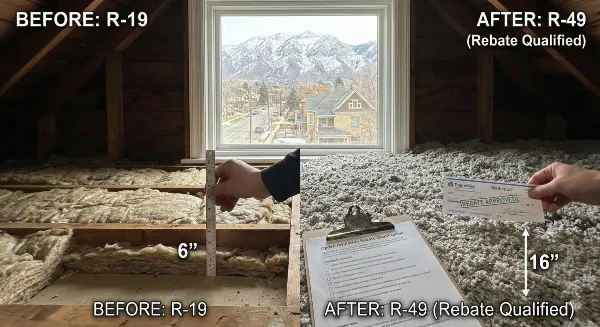
In 2026, the threshold for a Utah insulation rebate typically requires that your existing attic insulation has an R-value of R-20 or less.
The "Visual" Test: If you look into your attic in an older North Ogden bungalow and can see the wooden floor joists peeking through the pink fiberglass or grey cellulose, you are almost certainly under R-20. Generally, R-20 is about 6 to 7 inches of insulation.
The Goal: To receive the rebate, you must increase that insulation to a final value of at least R-49 (roughly 15–18 inches depending on the material).
For Wall and Floor Insulation
If you live in a historic home near 25th Street or the East Central area, your walls might have no insulation at all.
Wall Insulation: To qualify, the wall must currently have little to no insulation. You must add at least R-13 to the exterior walls.
Floor Insulation: This applies to floors over unconditioned spaces (like a crawlspace). The existing level must be R-11 or less, and you must upgrade it to at least R-30.
4. Neighborhood Context: Age of the Home
Your Ogden neighborhood can often tell you a lot about your likelihood of qualifying.
Historic Districts (Jefferson, Lower East Bench): Homes built before 1970 are the prime candidates for these programs. Many of these residences were built with minimal insulation that has settled or degraded over the decades. If you haven't touched your attic since the 90s, you are likely a "shoe-in" for the maximum rebate.
Newer Developments (Shadow Valley, The Highlands): Programs like Wattsmart typically exclude homes built after 2015, as these were constructed under stricter energy codes that already require high R-values. If your home was built in the last 10 years, you likely already have R-49 in the attic, making you ineligible for the "upgrade" incentive.
5. Professional vs. DIY: Does the Installer Matter?
Both ThermWise and Wattsmart allow for "Self-Installed" insulation, but the qualification rules change slightly.
Professional Installation: If you hire a Program-Qualified Contractor, the rebate amount per square foot is usually significantly higher. These contractors are vetted by the utility companies and know exactly how to document the "before and after" to ensure your check isn't delayed.
DIY Installation: You can still get money back if you head to the local hardware store, rent a blower, and do the work yourself. However, you will only be reimbursed for the cost of materials (not your labor), and you must keep every single receipt and take clear photos of the insulation depth scales.
6. The 2026 Federal Bonus: The 25C Tax Credit
While you are looking at local utility rebates, don't forget the federal government’s contribution. As of 2026, the Energy Efficient Home Improvement Credit (25C) allows homeowners to claim a tax credit of 30% of the cost of weatherization materials, up to $1,200 annually.
Because this is a federal tax credit, it can usually be "stacked" on top of your Ogden utility rebates. This means a project that costs $2,000 could potentially see a $400 rebate from the utility and a $600 credit on your year-end taxes, cutting the effective price in half.
7. Submission Deadlines and Documentation
Even if your home is a perfect candidate, you won't get paid if you miss the paperwork window.
The 180-Day Rule: Most Utah programs require you to submit your application within 6 months (180 days) of the installation date.
Required Paperwork: You will need your utility account number, an itemized invoice showing the square footage covered and the R-value added, and (in some cases) a "Third-Party Payment Addendum" if you want the check sent to someone other than the account holder.
Summary Checklist for Ogden Residents
To summarize, you likely qualify for an insulation rebate if:
[ ] You receive a bill from Rocky Mountain Power or Enbridge Gas.
[ ] Your home was built before 2015.
[ ] Your attic has less than 7 inches of existing insulation.
[ ] You have central air or a natural gas furnace.
[ ] The area being insulated is between a "conditioned" (heated/cooled) room and an "unconditioned" space (like the attic or a crawlspace).
If you meet these criteria, your next step is to contact a qualified weatherization contractor in Northern Utah for a free estimate. Not only will you get a check back from the utility company, but you’ll also notice an immediate difference in how often your HVAC system kicks on during those windy Ogden nights.
