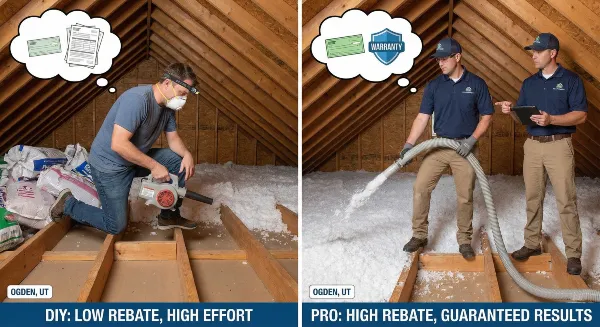
DIY vs. Professional: How to Secure Your Insulation Rebate in Ogden, Utah
Whether you are looking out over the Great Salt Lake from West Ogden or nestled against the foothills in Shadow Valley, every Ogden homeowner faces the same winter dilemma: how to keep the warmth in without emptying their bank account. As utility costs fluctuate in 2026, the appeal of Utah insulation rebates has never been higher.
However, one of the most frequent questions asked by the weekend warriors in the Jefferson District or the East Bench is: "Can I just do this myself, or am I required to hire a professional to get my money back?"
The answer is a bit more nuanced than a simple "yes" or "no." While both major Utah utility programs—ThermWise (Enbridge Gas) and Wattsmart (Rocky Mountain Power)—offer pathways for DIYers, the requirements and the final check amounts differ significantly.
The DIY Path: For the Ogden Weekend Warrior
If you’re the type of person who enjoys a Saturday morning at the local hardware store and isn't afraid of a little "attic snow" (loose-fill insulation), you’ll be happy to know that you can qualify for a rebate through self-installation.
How the DIY Rebate Works
In 2026, the DIY path is designed to reimburse you primarily for the cost of materials. Here is what you need to know if you're planning a solo mission in your North Ogden bungalow:
Material Reimbursement: Programs like ThermWise typically offer a flat rate or a percentage based on your receipts. You won't be "paid" for your time, but you can significantly offset the cost of the blowing wool or fiberglass batts.
The Documentation Burden: As a DIYer, the "proof of work" falls entirely on your shoulders. You must provide itemized receipts showing exactly how many bags or rolls were purchased.
The Photo Requirement: Most utility companies now require "before and after" photos. This is especially important in older East Central homes where you need to prove you started with a low R-value (usually R-20 or less) and ended at the required R-49 or R-60.
The DIY Risk: The biggest hurdle for self-installation is "Attic Prep." To truly qualify and see the energy savings, you must also perform air sealing. If you just blow insulation over open gaps around your light fixtures or plumbing stacks, you're essentially putting a sweater over a mesh shirt. Some rebates require proof of air sealing, which can be tricky for a novice to document correctly.
The Professional Path: Using a Program-Qualified Contractor
For many residents in South Ogden or the Mount Ogden area, hiring a pro isn't just about avoiding a dusty attic; it’s about maximizing the rebate.
Why the Pro Rebate is Usually Higher
Utility companies prefer professional installations because they are predictable. A Program-Qualified Contractor (PQC) has been trained on the specific standards required by Rocky Mountain Power and Enbridge Gas.
Higher Incentives: Generally, the "Professional" rebate tier offers a higher "cents-per-square-foot" payout. This is because the utility trust that the air sealing was done to code and the insulation was blown to the correct density.
Instant Rebates (The "Buy-Down"): In 2026, many Ogden contractors offer an "instant rebate." Instead of you filling out paperwork and waiting 8 weeks for a check, the contractor deducts the rebate amount directly from your invoice. They take on the paperwork burden, and you just pay the lower net price.
Specialized Equipment: Professionals use high-volume blowers that can reach the far corners of a deep attic in a Shadow Valley estate much more effectively than the rental units available at big-box stores.
Comparing the Two: Which is Right for Your Ogden Home?
To help you decide which route to take, let’s look at a side-by-side comparison for a typical 1,500-square-foot attic in the Lower East Bench.
Feature DIY Installation Professional Installation
Rebate Amount Lower (Material costs only) Higher (Square-foot based)
Effort Level High (Labor, rental, cleaning) Low (Handled in 4–6 hours)
Air Sealing Often skipped (Reduces savings) Included (Maximizes efficiency)
Paperwork You handle everything Contractor usually handles it
Warranty None (Manufacturer only) Labor and Material Warranties
The "Middle Ground": The DIY Prep
Some Ogden homeowners choose a hybrid approach. They might handle the "dirty work" of removing old, soiled insulation or sealing up the gaps around the chimney and recessed lights in their Lynn neighborhood home, and then hire a professional to blow in the fresh R-60 cellulose.
While this saves on labor costs, be careful: some rebate programs require the entire project to be handled by a PQC to qualify for the higher-tier professional rebate. If you do the prep yourself, make sure you aren't accidentally disqualifying the final "blow-in" incentive.
Critical Rules for Both Paths in 2026
Regardless of whether you are a DIY enthusiast or you’ve got a contractor on speed dial, three rules remain absolute for Utah insulation rebates:
The "Before" Measurement: You cannot get a rebate if your attic already has a high R-value. In 2026, the threshold is typically R-20 or less. If your South Ogden home already has 10 inches of insulation, you likely won't qualify for a rebate to add more.
The 180-Day Deadline: You have exactly 6 months from the date of purchase (for DIY) or the date of installation (for Pros) to get your application postmarked or submitted online.
The Account Holder Rule: The rebate must be tied to the person whose name is on the Rocky Mountain Power or Enbridge Gas bill. If you are a renter in the Avenue District, you’ll need to coordinate with your landlord to ensure the rebate is processed correctly.
Final Verdict: Pro or No?
If you live in a smaller, straightforward home in West Ogden and have a long weekend to spare, the DIY route can be a rewarding way to save money on materials.
However, if you live in a historic East Bench home with complex rooflines, knob-and-tube wiring (which must be handled carefully with insulation), or multiple levels, hiring a Program-Qualified Contractor is almost always the better financial move. Between the higher rebate tiers and the immediate energy savings from professional air sealing, the "pro" path often pays for itself faster than the DIY route.
Before you make a move, check the current 2026 rebate tables on the ThermWise or Wattsmart websites. Your Ogden home—and your wallet—will thank you when that first sub-zero canyon wind starts to blow.
